
One-Stop Student Services Staffing: How to build an effective higher education service center team

Strengthening the student experience with a well-staffed one-stop student service center.
Across higher education, one-stop student service centers are transforming how institutions support students and families. Rather than navigating multiple offices across campus, students access critical services—such as financial aid, registration, academic records, and billing and payments—through an integrated service hub.
When departments work together, colleges and universities strengthen their service experience, and one-stops, at their best, aim to make the higher education administrative experience easy and accessible for their most important audiences.
But delivering service excellence in a one-stop is more than co-located services. It requires the right people with the right mix of expertise, adaptability, and commitment to helping students succeed.
The Staffing Challenge: One-stop roles are unique
One of the greatest challenges in one-stop development is staffing. While the integrated student service model is gaining traction, it often stands as a unique function within a traditional setting. While you’re pulling together expertise, you’re not replicating roles found within the existing campus structure.
As a result, building the right team frequently takes longer than most colleges anticipate. Even before HR is engaged, schools need someone to lead the process and to answer fundamental questions, including:
What roles should exist to create an efficient structure?
What’s included in their job descriptions?
How will these positions overlap or work with other existing departments?
What’s the right level of leadership vs. front-line staff?
While we have successful frameworks to pull from, there isn’t a uniform one-stop staffing model – each is unique to the goals and realities of that institution. That being said, we’ve developed guidelines and supporting tools to help student service leaders navigate this process.
Building the right team for your one-stop
The staffing level and hierarchy of your one-stop is both a product of the services you’re bringing together as well as the funding your program receives. While there isn’t a one-size-fits-all approach, there are several roles that can make your one-stop a more efficient operation.
One-stop director – The strategic leader who focuses on institutional alignment, managing relationships across campus units, and advocating for the one-stop’s role within broader institutional priorities.
Associate/Assistant directors – Associate/Assistant directors serve as operational leaders who can oversee elements of the center’s direction as well as focus on the day-to-day management of front-line service delivery.
Data analysts – Benchmarking and data-driven decision-making are pivotal across an institution, but particularly for a one-stop center. A data analyst supports staffing projections, monitors service trends, measures service performance, and provides ongoing reporting for leadership.
Training professionals – Given the need for front-line workers with knowledge across service areas, training professionals are responsible for ensuring the front-line staff have the information and tools needed to provide service excellence.
Front-line workers - Front-line staff play one of the most important roles in a service center. These generalists must support students across multiple service areas. To provide adequate service, ensure you have the right number of positions in place and that these individuals are sufficiently trained.
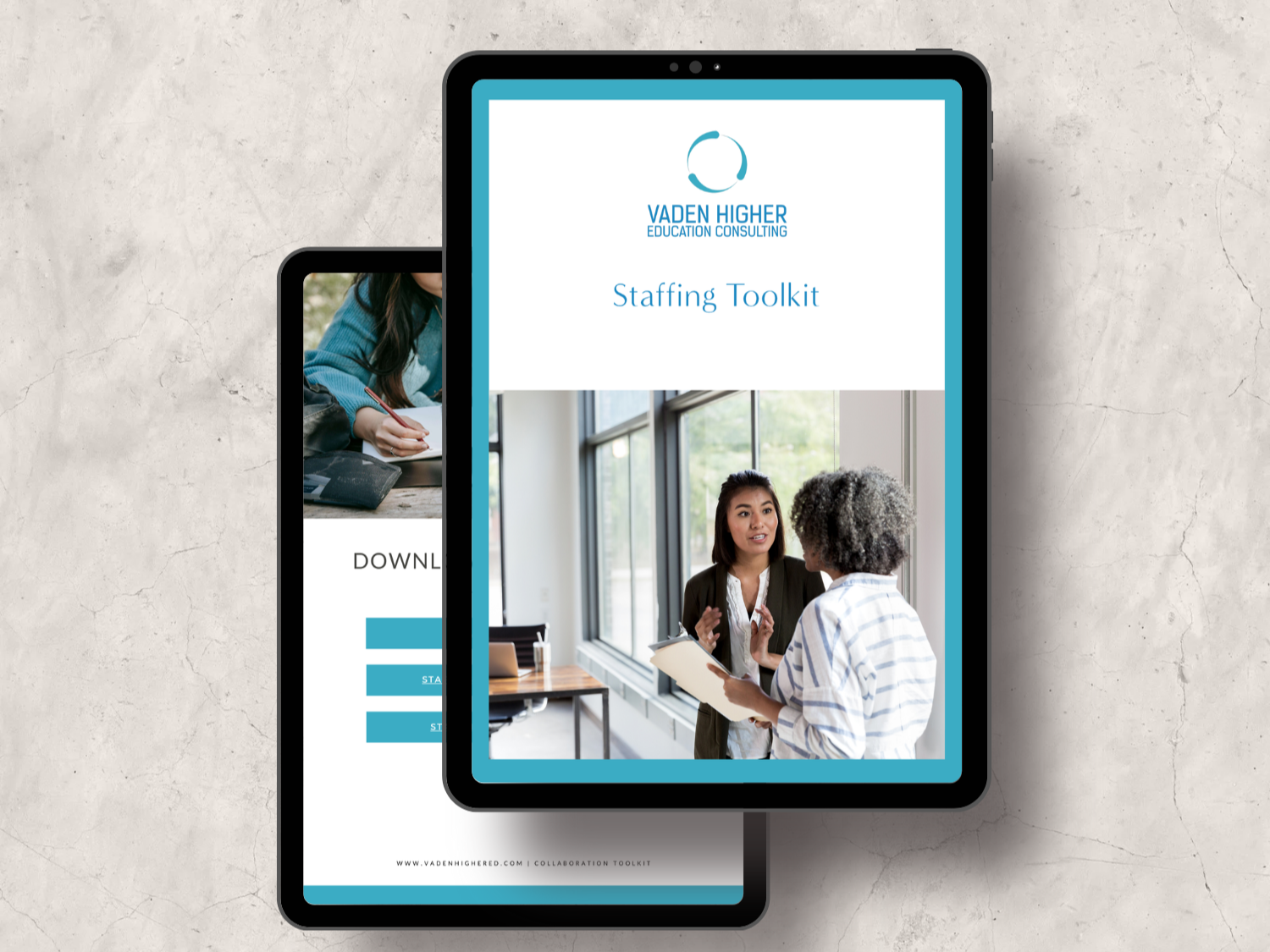
Vaden Consulting’s One-Stop Staffing Toolkit
To help schools calculate the number of front-line staff they’ll need, we’ve created plug-and-play resources to help you determine the appropriate staffing levels you’ll need, based on your school’s current service trends. We also have staffing projection models to ensure you’re meeting service needs at peak times, as well as sample work schedules for your front-line team.
Staffing considerations
Because one-stops serve a unique role within a college or university, some practices can be helpful before you begin implementation to ensure a smoother process.
Talk to HR early
Because one-stop roles frequently differ from traditional campus positions, early collaboration with human resources is essential.
It can often take longer than expected to formalize job descriptions and to work through classification questions, compensation structures, and reporting relationships before hiring begins. Some functions may also have specific regulatory or institutional requirements that affect how roles and responsibilities are defined.
Institutions should consider making a one-stop director their first hire. In turn, that individual can support the planning process, which will typically include shaping the staffing model, defining job descriptions, and advocating for the roles needed to make the center successful.
Hiring internally vs. externally
Another important decision is whether to staff the one-stop primarily with existing institutional employees or recruit new hires into vacant roles.
Existing staff bring deep institutional knowledge and subject-matter expertise that can help train others and navigate complex policies. However, moving experienced staff into new roles may create knowledge gaps in their previous departments. Institutions must also consider whether employees truly want to transition into these roles and how to appropriately incentivize those with valuable expertise to make the move.
Hiring new staff allows institutions to recruit individuals specifically aligned with the one-stop service model. However, onboarding may take longer as new employees learn institutional processes.
Questions to ask when staffing a one-stop
To determine the staffing structure that will work best for your one-stop, here are foundational questions to ask:
What services should the one-stop provide, or what departments will it represent?
What is the expected volume of contacts, and how does this volume vary throughout the year?
What staffing model is needed to meet demand (generalists, specialists, tiered support, internal vs. outsourced support)?
What is the general complexity of the inquiries (transactional versus counseling)?
What leadership structure is needed to effectively support both day-to-day operations and longer-term strategy?
What level of investment is available to build and sustain the team?
A foundation for service excellence
Ultimately, the success of a one-stop student services center depends on the people delivering the experience.
When institutions intentionally design roles, build a balanced leadership structure, and invest in the right mix of staff expertise and service orientation, they create a foundation for service excellence.
A thoughtful staffing model not only supports efficient operations – it enables institutions to deliver on the promise of the one-stop: a simpler, more connected, and more supportive experience for students and families.
Need support building an effective one-stop for your institution? Let’s connect.
